
Urbanization & Changing Landscapes
When we look at contemporary civilization, we often reflect on our existence over the past 5000 years. We ask whether human habitation has expanded beyond measure, or whether the transformations have been gradual. Change is inevitable for humankind, and we as humans have moved through these changes, affecting the ecology and the environment at large. Looking at Indian civilization, which began with the Indus Valley Civilization along the Indus and Saraswati rivers, and continued with the Gangetic Civilization along the Ganges and its tributaries after the arrival of the Aryans, we see that almost every Indian civilization developed beside the major rivers. This allows us to infer that human habitats revolve around three sustainable elements — water, land and air.
Both nature and humans are responsible for changing the landscape. While we can govern human alteration, we have no authority over nature; yet we are primarily the cause of nature’s changes. We should therefore reconsider and curb our behaviour toward nature, so that this planet remains sustainable for future generations.
From the beginning of human existence, we have been shaping the landscape. Through every period of our history we have remained dependent on these three sustainable elements, but with rising population we have urbanized rapidly. We are the current inhabitants of this planet, and we are — knowingly or unknowingly — moving toward an unsustainable course. We prioritize the immediate and disregard what is to come, even as our future grows perilous. Our selfish actions are pushing the next generation toward extinction.
My present project is Urbanization & Changing Landscapes of Navi Mumbai. Mumbai was formed by the unification of seven islands into a vast concrete jungle, transforming the life cycle of its original inhabitants — the Agri and Koli communities. When the demand for housing increased in Mumbai, a new city was created on barren land filled with salt pans and fishing villages. Mumbai and its surrounding areas were ringed by water bodies. With rapid urbanization, many of these water bodies were reclaimed; others were left polluted by industry, killing the fish and making the Koli community’s traditional fishing unsustainable. The salt pans and farmlands of the Agri community were turned into concrete, and the Agri and Koli communities were forced to leave their traditional work and join the mainstream.
In my work I adopt the three sustainable elements of the earth: land as mother (the womb that gives birth), air as the aura of life, and water as the lifeline through which humanity survives. We must find balance among these elements, and recognize that any asymmetry will bring catastrophe and shorten our continued existence. My work addresses the growing ecological imbalance of the present generation — a state brought on by the abuse of power, human greed, and materialistic ambition. I have tried to depict humanity’s exploitation of the natural world and the suffering of its flora and fauna, and to convey my apprehension about ecology and environmental catastrophe through painting. I am passionate about nature, and the continuous changes in the landscape of Navi Mumbai have compelled me to make environment and ecology my subject. I try to find an aesthetic within this work.
My medium is oil on canvas, integrated with charcoal — a harmonious blend through which I depict the metaphorical changes in ecology, the changing landscapes, with my own creativity taking on the voice of a member of an aboriginal tribe caught at the crossroads of development. My work employs a variety of brushstrokes, techniques and palettes, evolving a style of naturalistic, impressionistic and simplified forms with heavy outlines, sharp contrasts and emotional composition — creating an internal agitation within the subject. The work circles around the subject’s struggle and internal resistance, depicting a state of mind rather than an extreme reality.
I am trying to create an awareness that rapid development is leaving an inevitable mark on the environment, creating imbalance in ecology and uncertainty for our future generations. I have been working on landscape for more than a decade, and the subject of my work is environmental degradation. My endeavour is to document these changes and archive them through my work.
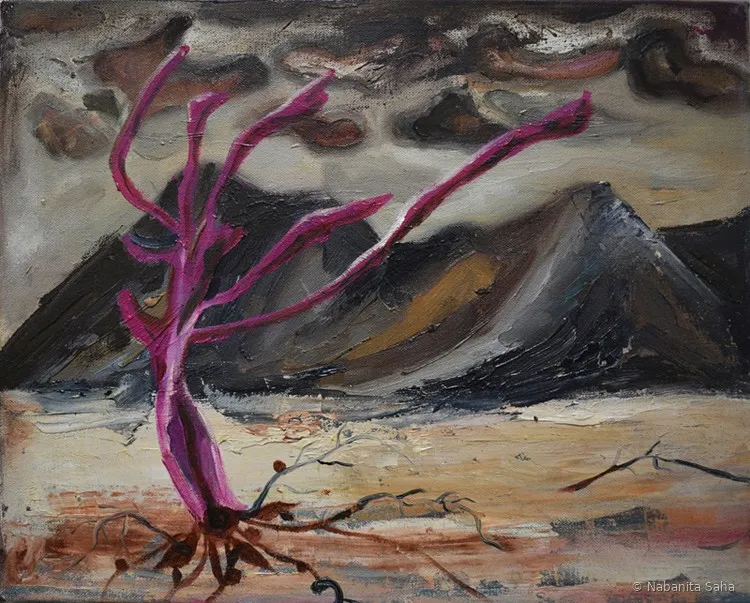
Chronicle of Distress 5 · 2017
Oil on canvas · 31 × 38 cm
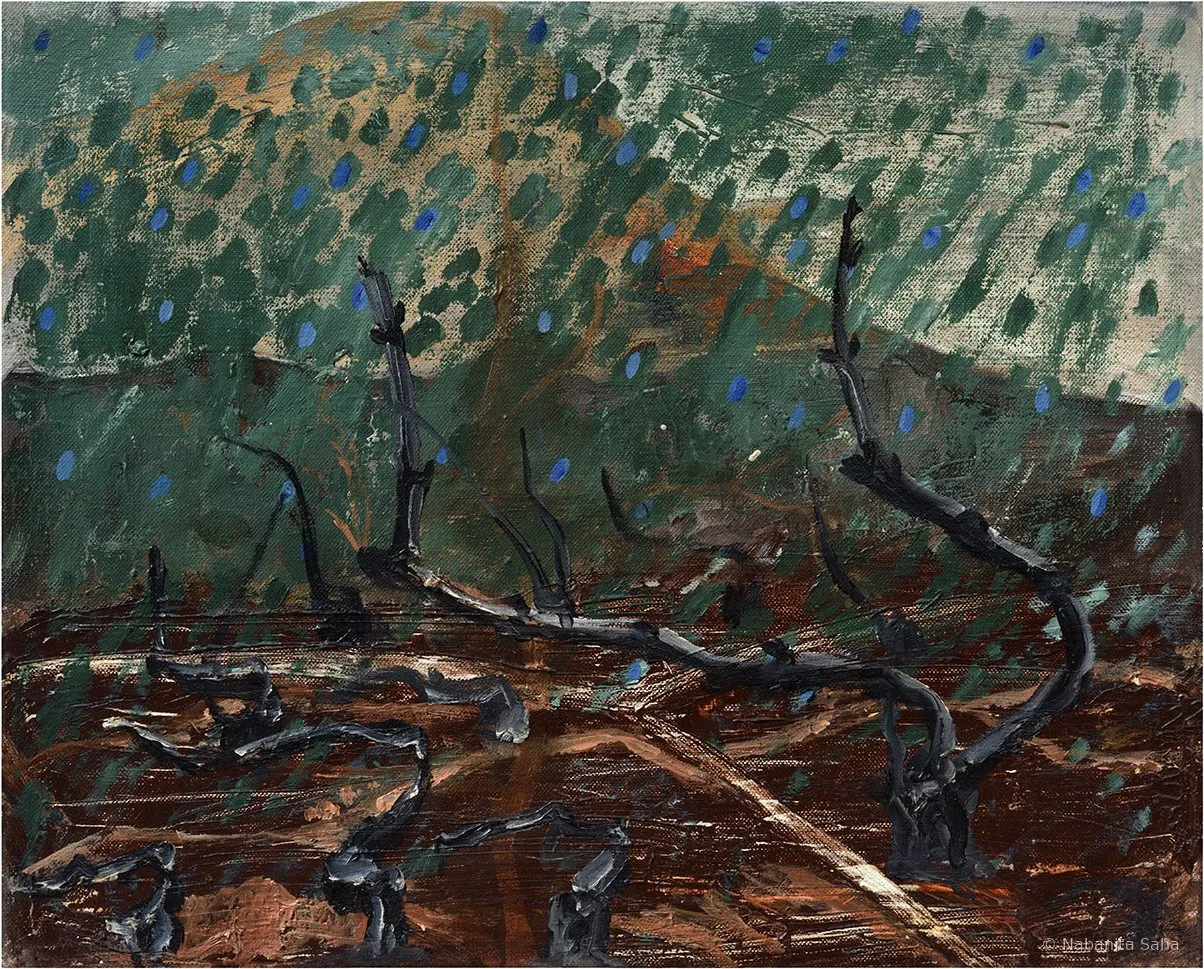
Diabolical Metamorphosis 4 · 2017
Oil on canvas · ≈31 × 38 cm
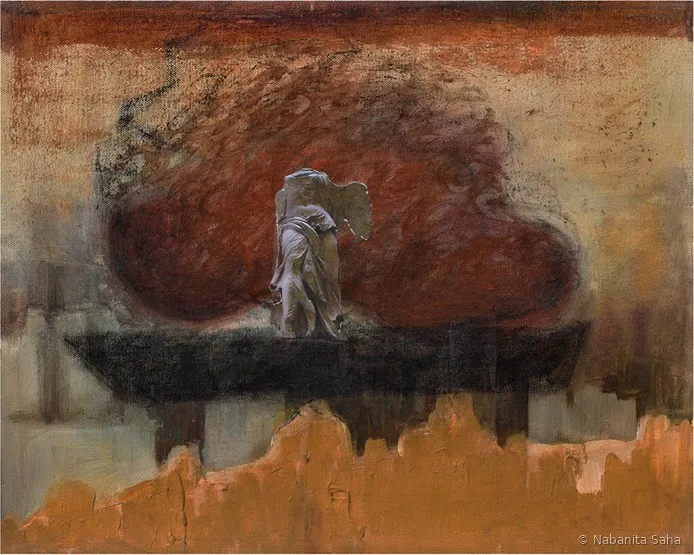
Metaphorical Essence 1 · 2017
Oil colour, print and charcoal on canvas · 31 × 38 cm
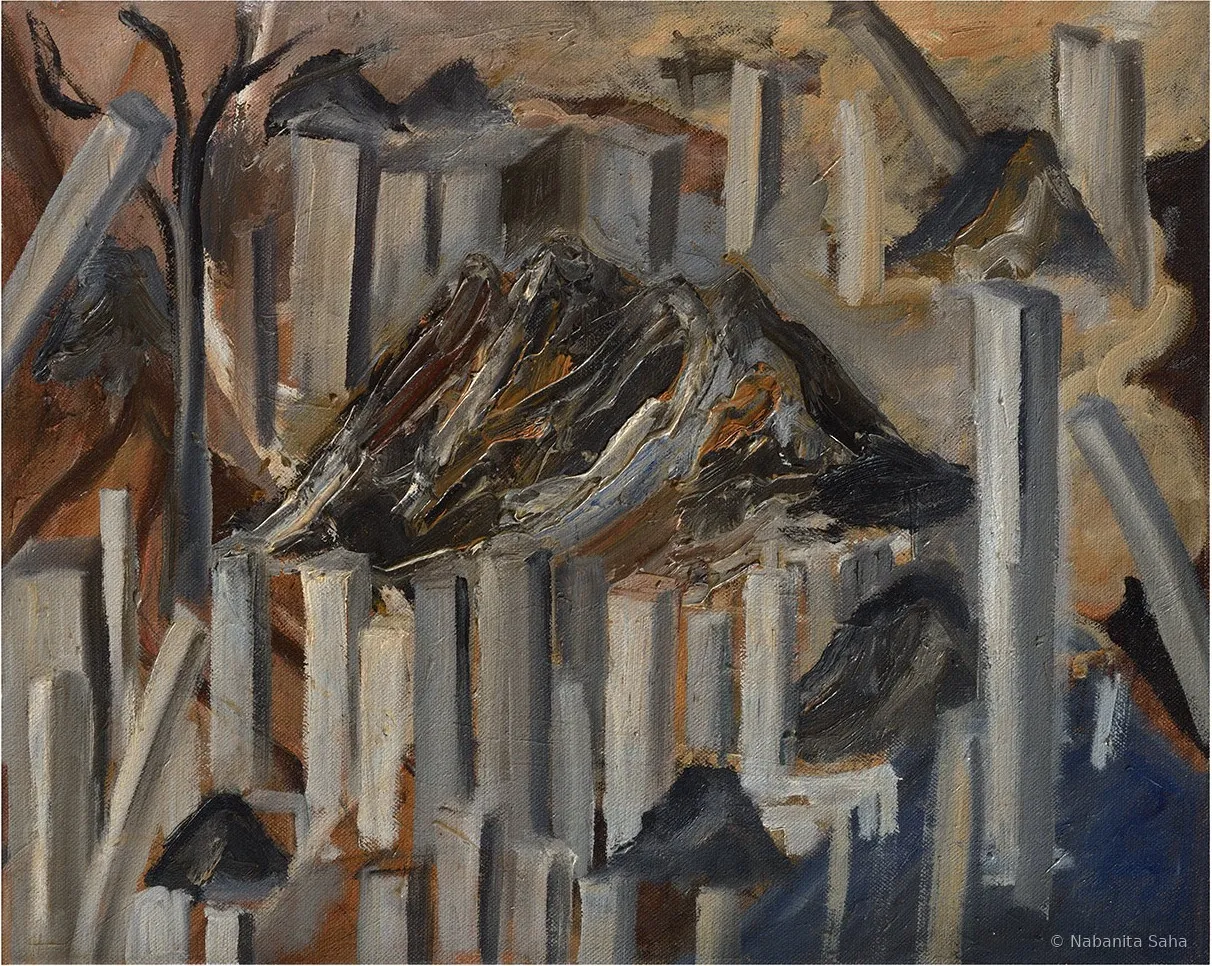
Obelix of Destiny 1 · 2017
Oil on canvas · 31 × 38 cm
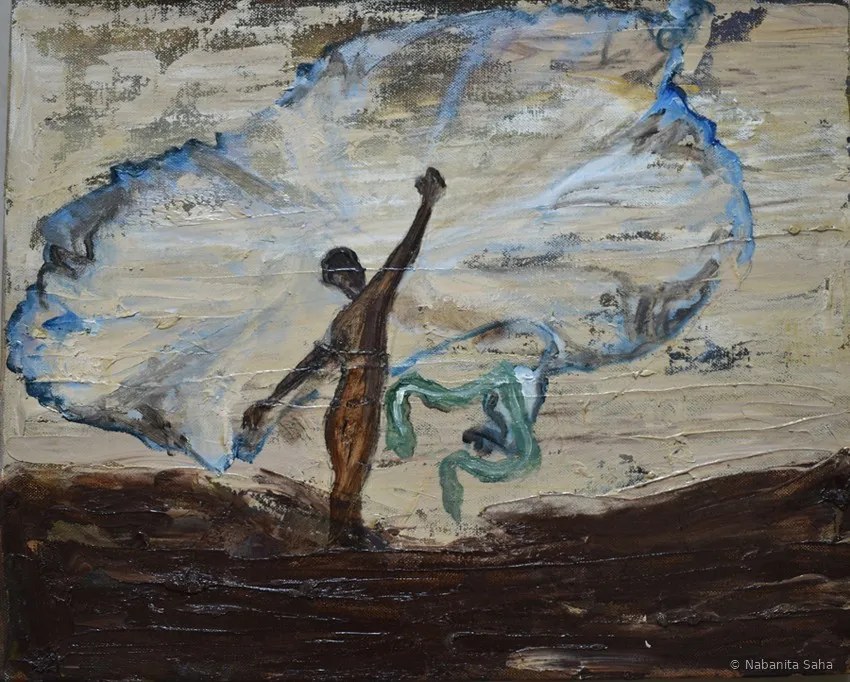
The Melancholy Journey 2 · 2017
Oil on canvas · 31 × 38 cm