
Inverted Firmament
My engagement with the environment dates back more than a decade, to a time when I was travelling across India after my studies. Over the past decade, India has seen exponential growth, resulting in the degradation of natural resources and rapid changes in climatic conditions. I remember growing up looking at starry nights — a rare sight in any city today. The present generation has not seen them in real life, and cannot recognize what is missing. This is not what we wished for.
My previous works were inspired by my time in Navi Mumbai, India — a city that has been my muse and a prime source of creativity. I watched as distinct villages there grew into urban townships. On one side this development created human and urban progress; on the other, it created a profound imbalance in the ecology. I have been disturbed by this imbalance, which is not sustainable for our future generations. I have been working on this subject for several years now. My earlier project, Changing Landscapes of Navi Mumbai — Agri & Koli Heartland, was supported by a prestigious grant from the Pollock-Krasner Foundation in the USA. From that work the next project emerged, taking the subject of the Changing Topology of Navi Mumbai.
The idea was conceived while I was returning to Mumbai on a flight, observing the ground topology of Navi Mumbai at night before landing. The land looked like a starry night seen from above. I noticed that on every flight, the lights expanded as the city expanded. I also observed how the pollution from land and air made it difficult to see real stars from the ground. I therefore chose to name this body of work Inverted Firmament.
Pollution is a by-product of development, and is the real cause of stars getting lost from our vision. Yet with so much energy now spent on lighting our urban lives, the paradox is that the stars have come down to earth. The question is: at what cost? Are we to be mute spectators to these irreversible changes and destroy our habitat, or can we still live a sustainable life? These questions disturb me. I am in a state of shock and terror at the way we are progressing. We are caught in our own web, constructing a hallucination of existence even as we know our future is in peril — shutting our minds and procrastinating, leaving the consequences for some later generation. We blame authorities, the state, industries for causing this problem, but never take the first step ourselves.
As we have progressed and cities have grown, the night sky has changed. Today only a few stars remain visible because of pollution, while the city lights below grow more intense and more visible from above. The phenomenon has reversed: the city lights now hold prominence over the stars.
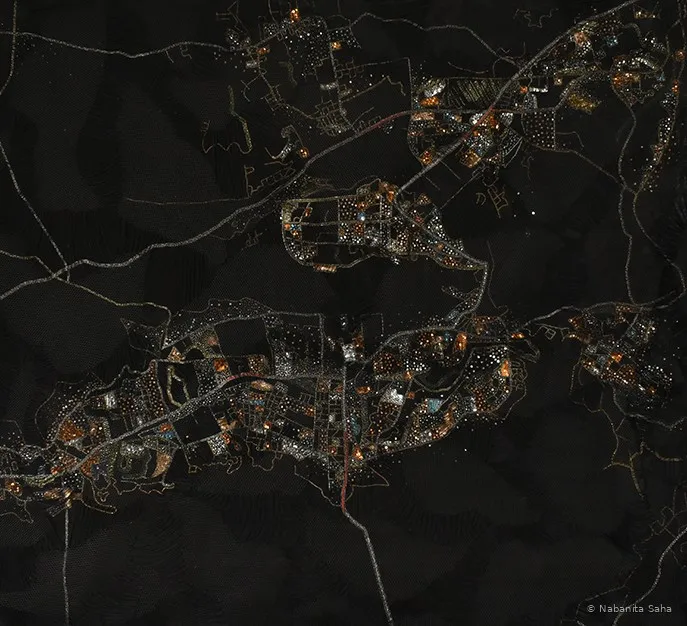
Inverted Firmament I · 2019
Mixed media — embroidery on fabric, cotton net and thread · 132 × 148 cm
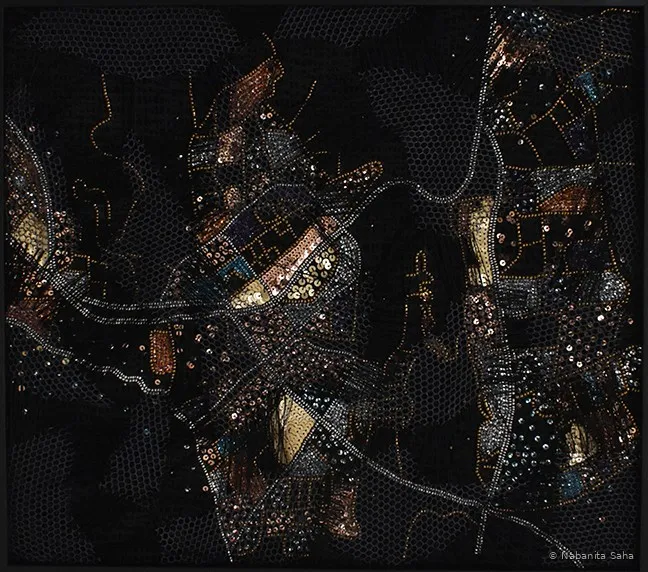
Inverted Firmament II · 2019
Mixed media — Embroidery in fabric, cotton net and thread · 41 × 46 cm
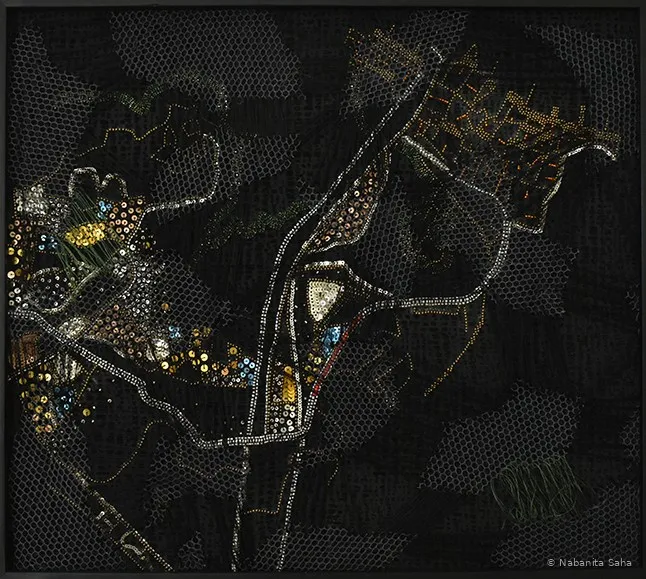
Inverted Firmament III · 2019
Mixed media — Embroidery in fabric, cotton net and thread · 41 × 46 cm
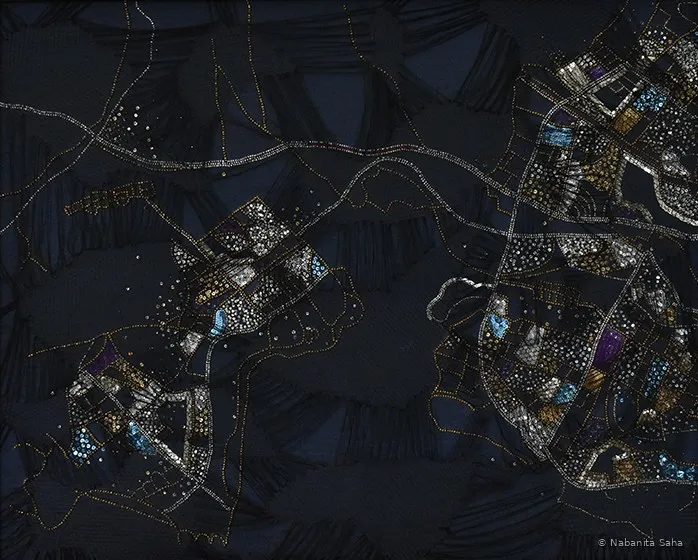
Inverted Firmament IV · 2019
Mixed media — embroidery on fabric, cotton net and thread · 61 × 76 cm
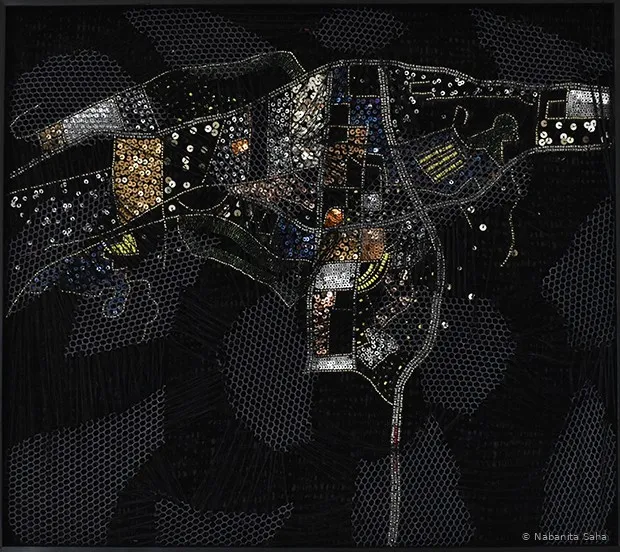
Inverted Firmament V · 2019
Mixed media — Embroidery in fabric, cotton net and thread · 41 × 46 cm
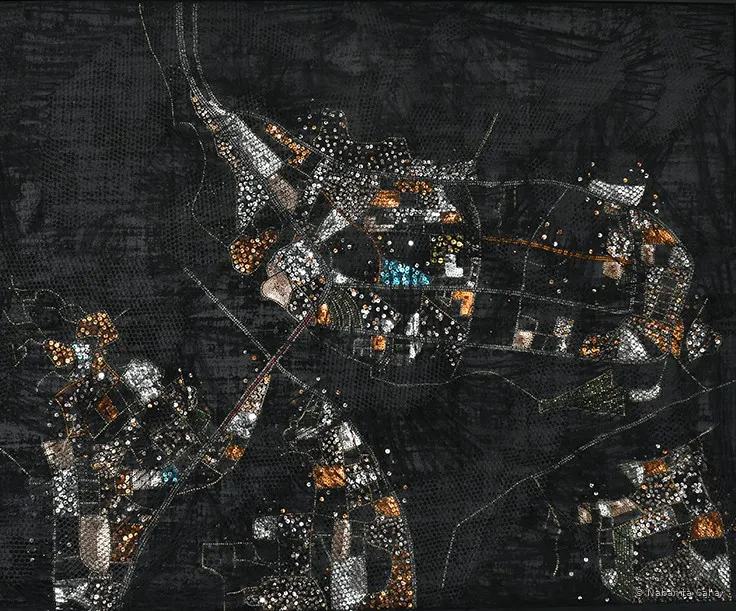
Inverted Firmament VII · 2019
Mixed media — embroidery on fabric, cotton net and thread · 61 × 76 cm
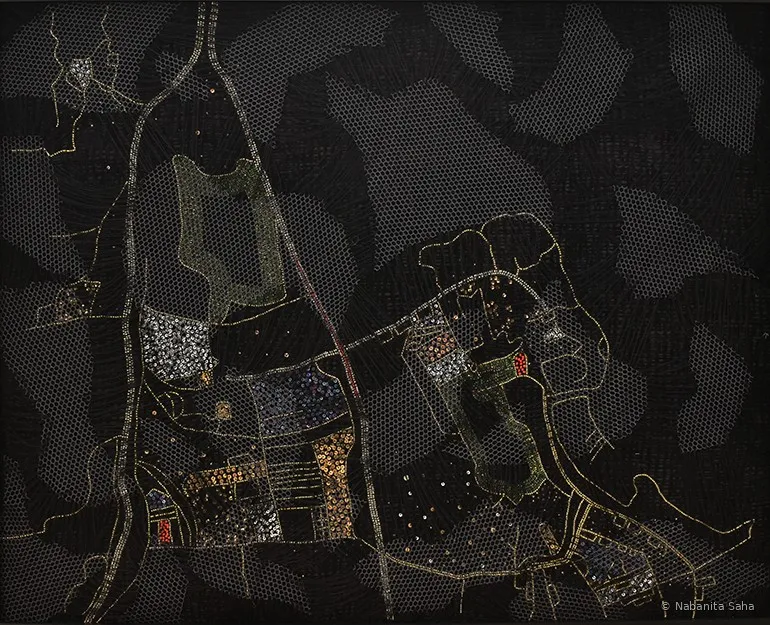
Inverted Firmament VIII · 2019
Mixed media — Embroidery in fabric, cotton net and thread · 61 × 76 cm